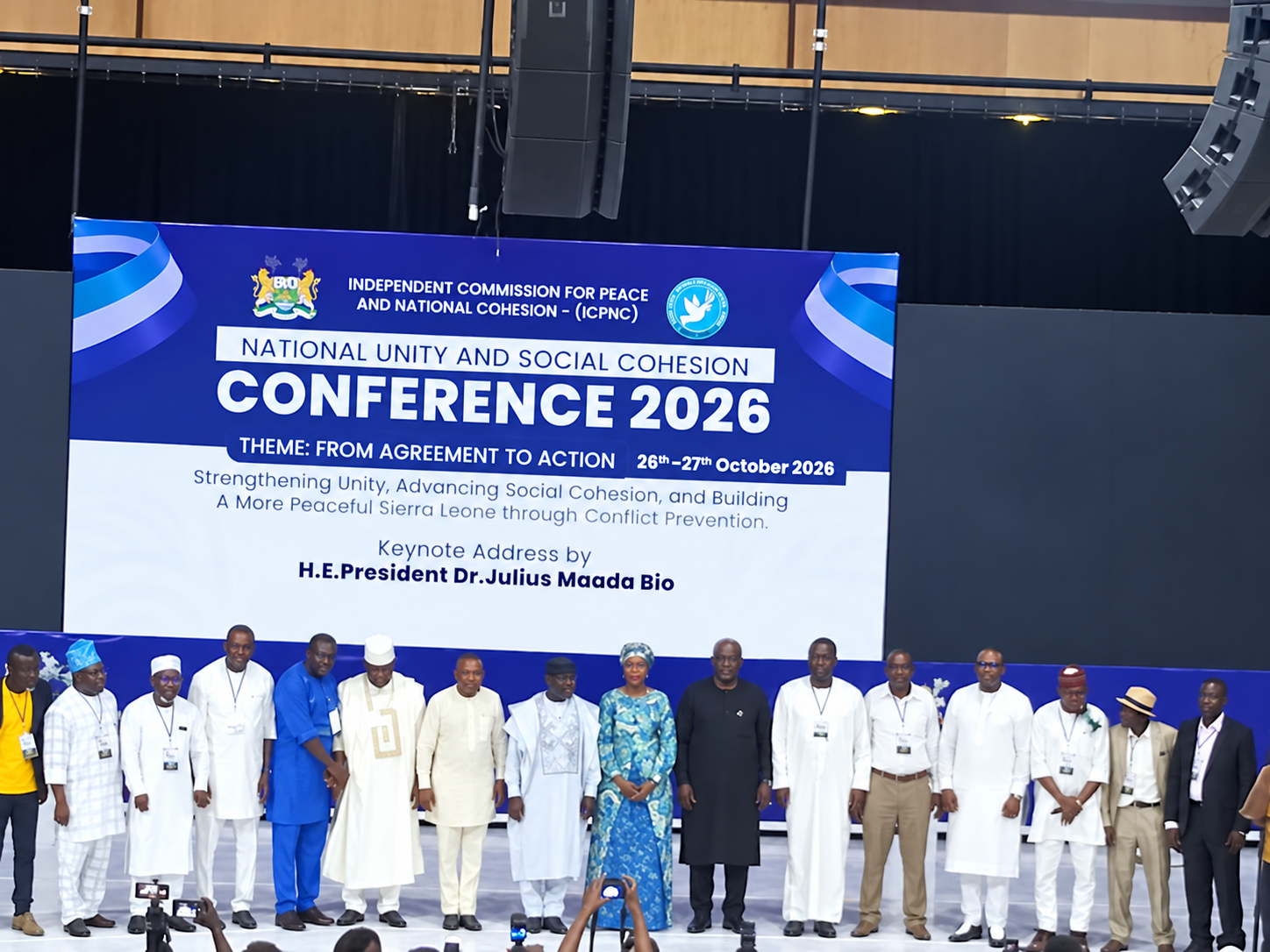
The Association for the Well-Being of Rural Communities and Development (ABC-Development) Sierra Leone has participated in the two-day National Unity and Social Cohesion Conference organised by the Independent Commission for Peace and National Cohesion (ICPNC), joining national leaders, international partners, civil society organisations and other stakeholders in discussions aimed at strengthening peace, reconciliation and national unity.
The conference, which commenced on Monday, October 26, and ended on Tuesday, October 27, 2026, at the Bintumani Conference Centre in Aberdeen, Freetown, provided a platform for stakeholders to discuss practical approaches to sustaining peace and strengthening social cohesion as Sierra Leone prepares for the 2028 general elections.
ABC-Development's participation highlighted the importance of civil society engagement in promoting peaceful coexistence, community development and national cohesion. The organisation joined other participating institutions in recognising the need for collective efforts to safeguard peace, encourage dialogue and strengthen relationships among communities.
A major highlight of the opening day was the participation of President Julius Maada Bio and former President Dr Ernest Bai Koroma, who called for national unity, political dialogue and collective responsibility in protecting the country's peace and democratic progress.
Delivering the keynote address, President Bio proposed a National Peace and Cohesion Action Framework to be published within 90 days. He said the framework would identify outstanding commitments, responsible institutions, implementation deadlines and measurable indicators of progress.
Reflecting on Sierra Leone's civil war, which officially ended in January 2002, President Bio acknowledged the country's progress through democratic elections, peaceful transfers of power and community-led reconciliation. However, he stressed that peace must become part of the country's national culture.
“Peace must therefore become part of our national culture. It must be visible in our institutions, in the trust people have in one another and in the way we treat one another,” he said.
The President outlined six proposals to strengthen national cohesion: a National Peace and Cohesion Action Framework, a Peace Basket Fund, a strengthened Inter-Party Dialogue Committee, a Code of Conduct for Peaceful Elections, peace and civic education in schools, and a National Peace Week.
With the 2028 elections approaching, he urged political leaders to reject violence, intimidation and appeals to religious, ethnic and regional divisions.
On transitional justice, President Bio acknowledged that survivors and families affected by the civil war were still awaiting assistance and justice. He said he had directed the National Commission for Social Action (NaCSA) and other relevant institutions to review and strengthen the reparations programme recommended by the Truth and Reconciliation Commission (TRC). He also called for a public report on the implementation of the TRC recommendations in January 2027.
Former President Dr Ernest Bai Koroma pledged his support to President Bio, offering to share his experience in promoting national unity and development. He emphasised that presidential responsibility extended beyond governance to keeping the country united.
“The responsibility of a President is not only to govern, but also to hold the country together. That is no small responsibility,” Koroma said.
He urged Sierra Leoneans to acknowledge past mistakes, accommodate one another and avoid allowing political affiliations to undermine national unity. He further assured President Bio that he remained available to contribute to national development.
The Board Chairman of the ICPNC, Rev. Shodankeh Johnson, said the commission's five years of existence provided an opportunity to renew the country's commitment to peace, justice, unity and reconciliation.
He explained that sustainable peace required more than the absence of conflict, stressing the importance of justice, inclusion, accountable leadership and peaceful resolution of grievances.
Rev. Johnson highlighted the commission's work in mediation, community engagement, conflict analysis and early-warning systems. He also proposed a National Peace Basket Fund to mobilise resources from government, the diaspora, the private sector and international partners to support peace monitors, mediators and community-based initiatives.
The Head of the United Nations Office for West Africa and the Sahel (UNOWAS), Leonardo Santos Simão, commended the ICPNC for promoting dialogue and reconciliation. He described Sierra Leone's transition from civil war to democratic governance as an example of recovery and resilience in Africa.
Simão stressed that sustaining peace required continuous investment in trust between citizens, institutions, political actors and communities. He also recognised the contributions of President Bio and former President Koroma to national dialogue.
Similarly, the Deputy British High Commissioner to Sierra Leone, Mehdi Hussain, urged political leaders to protect the country's democratic progress ahead of the 2028 elections. He emphasised the importance of responsible political communication, people-centred policies, civic space and media freedom.
The second day featured statements from representatives of various institutions, who reiterated the importance of collective responsibility in maintaining peace and national cohesion.
Delivering the keynote address on Day Two, Vice President Dr Mohamed Juldeh Jalloh called on Sierra Leoneans, both at home and abroad, to embrace unity and work together towards a peaceful and prosperous future.
The conference concluded with renewed calls for stronger collaboration among government institutions, political leaders, civil society organisations, development partners and citizens to translate commitments into practical actions that promote lasting peace.
For ABC-Development Sierra Leone, participation in the conference reinforced the importance of civil society involvement in national conversations on peacebuilding, reconciliation and social cohesion. It also highlighted the need for continued community engagement and collective responsibility in building a peaceful, inclusive and united Sierra Leone.