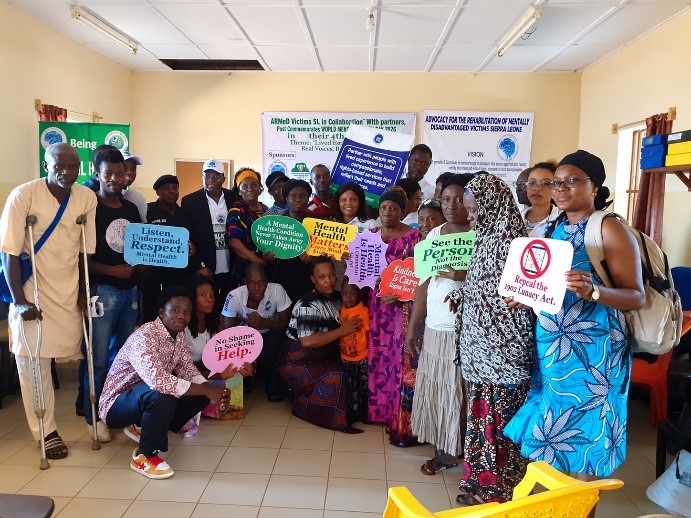
The Association for the Well-Being of Rural Communities and Development (ABC-Development) Sierra Leone has joined other civil society organisations, government institutions and mental health advocates at the fourth Mental Health Symposium organised by the Advocacy for the Rehabilitation of Mentally Disadvantaged Victims Sierra Leone (ARMeD Victims SL), in a collective call for greater mental health awareness, improved access to care and an end to stigma and discrimination.
The symposium, held on Thursday, October 29, 2026, at the Approved School in eastern Freetown, brought together stakeholders to commemorate World Mental Health Day 2026 and discuss the challenges confronting people experiencing mental health conditions, while exploring practical approaches to improving their well-being and social inclusion.
Held under the theme “Lived Experiences Heard, Real Voices, Real Change,” the event provided a platform for beneficiaries to share their personal experiences, engage with stakeholders and advocate for more inclusive mental health services.
ABC-Development's participation reflected the importance of civil society engagement in promoting community well-being, supporting vulnerable populations and strengthening public awareness of issues affecting individuals and families. The organisation joined other participating institutions in recognising the need for collective action to address mental health challenges and promote dignity, inclusion and access to appropriate support.
Among the institutions represented were the Ministry of Social Welfare, the Ministry of Health, Epilepsy SL, the Ballanta Academy of Music and Performing Arts (BAMPA), alongside other organisations and advocates whose contributions highlighted the importance of mental health education, appropriate care and shared responsibility.
Speaking at the symposium, Lucy Cecilia Lamin, Founder and Executive Director of ARMeD Victims SL, called for an end to stigma and discrimination against people experiencing mental health challenges.
She emphasised that affected individuals deserve empathy, kindness and access to appropriate support rather than ridicule, rejection and social exclusion.
Lamin also highlighted the limited availability of mental health services in some communities, noting that inadequate access to care remains a significant challenge for affected individuals and their families.
“Mental health issues should be our concern. Let's stop the discrimination and stigma against people with mental health issues, and let's come together and support them. They need our support and care, so let's embrace them with empathy. Let's show love, kindness and humanity. Limited mental health services are another challenge,” she said.
Dr. Kitty Fadlu-Deen spoke about the potential of music to support emotional well-being, encourage relaxation and help people cope with difficult life experiences.
Drawing on her personal experiences, she explained how music had helped her navigate major challenges in her life. She encouraged participants to consider listening to music and engaging in musical activities as possible ways of managing stress and anxiety, while recognising that music complements rather than replaces professional mental health care.
She explained that music plays an important role in different social and cultural settings, from thanksgiving ceremonies and funerals to public and state occasions, because of its ability to communicate comfort, relaxation and emotional connection.
According to her, both calm and lively music can positively influence people's moods, providing opportunities for relaxation, happiness and self-expression.
Former Member of Parliament, Hon. Ibrahim Bundu, called for stronger government commitment to mental health services, urging policymakers to translate existing policies into practical action through adequate funding, stronger primary healthcare and effective partnerships with qualified community-based and civil society organisations.
He also drew attention to the challenges of poverty, stigma, social rejection and limited access to care faced by people experiencing mental health conditions and substance use disorders.
Bundu stressed that mental health challenges affect not only individuals but also their families and the wider community, making coordinated action essential.
A significant moment of the symposium was the testimony of Alusine Turay of Looking Town, who shared his personal experience of living with mental health challenges and the discrimination he had faced within his community.
He explained how counselling, therapy and victim support had contributed to his recovery, helping him regain confidence, dignity and social acceptance.
“I almost killed myself due to discrimination and stigma I always experienced in my community, but good counselling has helped,” he said.
His testimony reinforced the symposium's central message that listening to people with lived experiences is essential to understanding mental health challenges and developing meaningful interventions.
The fourth Mental Health Symposium concluded with renewed calls for stronger collaboration among government institutions, civil society organisations, communities and development partners to improve mental health awareness, expand access to support services and protect the rights and dignity of affected individuals.
For ABC-Development Sierra Leone and other participating organisations, the engagement highlighted the importance of making mental health a shared community development priority, ensuring that people experiencing mental health challenges are not marginalised but are instead supported, respected and given opportunities to live meaningful lives.